Email: SalesDept@topcomponents.cc

Skype: jinda808@vip.163.com

QQ: 119294586

WeChat: 

WhatsApp: +8613027986268
Language Translation
- • English
- • Русский язык
* Please refer to the English Version as our Official Version.
* Please refer to the English Version as our Official Version.
On November 6, 2025, Dalian University Holdings, a leading international semiconductor component distributor dedicated to the Asia Pacific market, announced that its subsidiary Pinjia has launched a Bluetooth headset solution based on the Airoha AB1585AM chip.
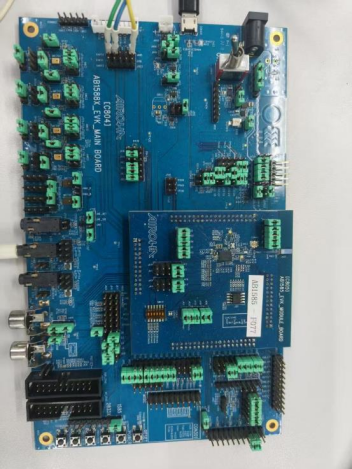
Figure 1- Display board of Dahua Pinjia's head mounted Bluetooth earphone solution based on Dafa Technology products
At present, the Bluetooth headset industry is taking big strides into a new stage of development. Consumers are no longer satisfied with basic functions, but have put forward higher requirements for sound quality, noise reduction, and wearing comfort. Meanwhile, with the increasing demand for intelligence and personalization, products with functions such as voice interaction and customized sound effects are also highly favored by consumers. In response to this trend, Da Da Da Da Da Pin Jia has launched a head mounted Bluetooth earphone solution based on Dafa Technology's AB1585AM chip. With excellent performance, it helps solution providers, machine manufacturers, and brand owners create a new generation of high-quality products, helping them seize opportunities and gain advantages in the fierce market competition.

Figure 2- Scene application diagram of Dahua Pinjia's head mounted Bluetooth earphone solution based on Dafa Technology products
AB1585AM is a highly integrated system in package (SiP) low-power Bluetooth audio chipset that integrates an application processor, digital signal processor (DSP), Bluetooth transceiver, and power management unit (PMU). The chip adopts a high-performance application processor, integrates an ARM Cortex-M33F core, operates at frequencies ranging from 1MHz to 260MHz, and is equipped with L1 cache, achieving efficient computation while also considering power efficiency. Its DSP subsystem is equipped with Cadence HiFi5 audio engine, with 1280KB zero latency memory and 32KB L1 cache. The frequency can be flexibly adjusted between 26MHz and 520MHz to meet the high load audio processing requirements.
The Bluetooth subsystem fully supports the Bluetooth 5.3 specification and has advanced wireless connectivity capabilities. The power management unit integrates 2 DC-DC buck converters, 1 SIDO converter, and 3 ultra-low static current LDOs to provide stable and efficient power supply support for the system. In addition, the chip supports linear chargers and can achieve programmable fast charging mode through a USB interface. With the help of System in Package (SiP) technology, the main module and PMU are highly integrated into a compact package, effectively reducing product size while significantly improving functional density.
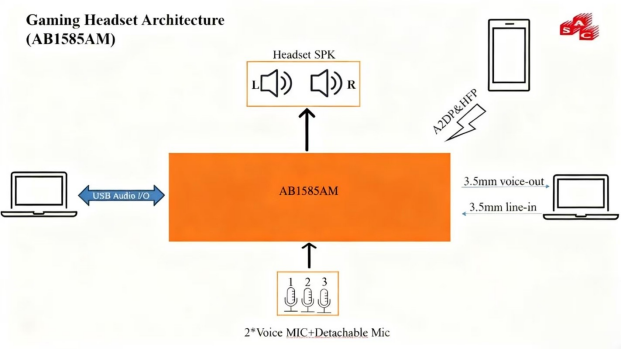
Figure 3- Block diagram of Dahua Pinjia's head mounted Bluetooth earphone solution based on Dafa Technology products
In terms of software, the Airoha IoT Software Development Kit (SDK) provides a rapid evaluation method for Bluetooth audio application development. It not only covers hardware abstraction layer drivers, connections, peripherals, and other functions, but also supports battery management, wireless firmware updates, and FreeRTOS. This platform adopts a three-tier architecture, and through the collaborative work of components at each layer, it can assist users in achieving efficient development.
Core technological advantages:
Highly integrated and low-power design:
Adopting SiP packaging technology, integrating the main control DSP、 Bluetooth RF and PMU significantly reduce PCB area;
Dynamic Voltage/Frequency Regulation (DVFS) supports a wide voltage range of 0.55V to 0.8V, optimizing power consumption and performance balance.
High performance audio processing:
HiFi5 DSP provides 4 times more neural network computing power than its predecessor and supports high-precision audio encoding and decoding (24 bit/192kHz);
Hardware ANC and voice wake-up function reduce system load and enhance real-time response capability.
Bluetooth connection reliability:
Supports Bluetooth 5.3 full features (including LE Audio and Isochronous Channels) to ensure low latency synchronization across multiple devices;
Integrate T/R switch and balun to reduce external components and enhance RF anti-interference capability.
Flexible scalability:
Rich peripheral interfaces (I2S, TDM, SPI, etc.), compatible with various sensors and external memory (such as serial Flash);
Capacitive touch and GPIO reuse design simplify human-computer interaction development.
Power and Charging Optimization:
Support intelligent charging box communication (1-Wire UART), compatible with Apple/non-standard charger detection;
Low static current design (PMU total standby current<3 μ A), extending battery life.
Scheme specifications:
Processor architecture:
Host processor ARM Cortex-M33F, with a maximum clock speed of 260MHz, supports FPU and MPU, 256KB zero wait memory (configurable as L1 cache or TCM);
The DSP subsystem is the Cadence HiFi5 audio engine, supporting neural network expansion, with a maximum clock frequency of 520MHz, integrated with 1MB data RAM and 256KB instruction RAM.
Bluetooth function:
Fully compatible with Bluetooth 5.3 standard, supporting dual-mode (classic Bluetooth+low-power Bluetooth) and synchronous channel (ISO);
Integrated PA (output power 15dBm), sensitivity up to -97dBm, supporting BLE 1M/2M rates;
Supports up to 4 ACL links and 4 BLE links, with hardware AGC and interference suppression capabilities.
Audio subsystem:
Uplink 3-channel microphone input (analog/digital), supporting up to 192kHz/24 bit sampling, integrated hardware ANC (feedforward/hybrid noise reduction);
One downlink output, up to 192kHz/24 bit, supporting Class G/D amplifiers, with an output power of up to 38mW (16 Ω load);
Asynchronous Sample Rate Conversion (ASRC), hardware gain control, Voice over Wake (VoW), and Voice Activity Detection (VAD).
Power management:
Wide input voltage range (3V~5V), integrated with 2 Buck converters, 1 SIDO converter, and 4 LDOs;
Supports BC1.2 charging protocol, JEITA temperature protection, maximum charging current of 0.5A, standby current as low as 0.1 μ A (Flash sleep mode).
Peripheral interface:
USB 2.0 device controller, 3 I2C, 2 I3C (up to 12MHz), 3 UART (up to 3Mbps);
Supports eMMC/SDIO, SPI master-slave interface, PWM, 12 bit AUX ADC, and capacitive touch control (3-channel).
Packaging and working conditions:
TFBGA package (4.2mm × 5.5mm, 110 pins, 0.4mm pitch);
The working temperature range is -40 ℃ to 85 ℃.
About The Author
This is reported by Top Components, a leading supplier of electronic components in the semiconductor industry
They are committed to providing customers around the world with the most necessary, outdated, licensed, and hard-to-find parts.
Media Relations
Name: John Chen
Email: salesdept@topcomponents.ru
This is reported by Top Components, a leading supplier of electronic components in the semiconductor industry. They are committed to p with the most necessary, outdated, licensed, and hard-to-find parts.
Media Relations Name: John Chen
Email: salesdept@topcomponents.ru