Email: SalesDept@topcomponents.cc

Skype: jinda808@vip.163.com

QQ: 119294586

WeChat: 

WhatsApp: +8613027986268
Language Translation
- • English
- • Русский язык
* Please refer to the English Version as our Official Version.
* Please refer to the English Version as our Official Version.
Currently, humanoid robots are gradually entering the stage of practical application deployment, and their landing pace depends on the development of physical intelligence and real-time reasoning capabilities. With the official launch of NVIDIA Jetson Thor platform, Analog Devices, Inc. (ADI) will further accelerate the development process of humanoid robots and autonomous mobile robots (AMR).
By fully integrating ADI's edge sensing, precision motion control, power integrity, and deterministic connectivity technologies with Jetson Thor's computing power, Holoscan Sensor Bridge, and Isaac Sim, both parties are working together to build a large-scale landing path from simulation to actual deployment for robots with reasoning capabilities.
Currently, humanoid robots are gradually entering the stage of practical application deployment, and their landing pace depends on the development of physical intelligence and real-time reasoning capabilities. With the official launch of NVIDIA Jetson Thor platform, Analog Devices, Inc. (ADI) will further accelerate the development process of humanoid robots and autonomous mobile robots (AMR).
By fully integrating ADI's edge sensing, precision motion control, power integrity, and deterministic connectivity technologies with Jetson Thor's computing power, Holoscan Sensor Bridge, and Isaac Sim, both parties are working together to build a large-scale landing path from simulation to actual deployment for robots with reasoning capabilities.
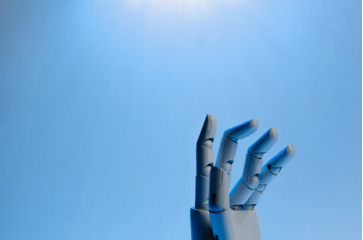
Image source: Pexels/Tara Winstead (C) 2021
A new benchmark for physical intelligence
Jetson Thor has redefined the possibilities of robotics technology. The platform is equipped with NVIDIA Blackwell GPU, Transformer engine, Multi Instance GPU (MIG) technology, 14 core Arm Neoverse V3AE CPU, and up to 128GB of LPDDR5X memory, capable of achieving server level AI computing performance of 2070 FP4 TFLOPS within the mobile level power consumption range. Meanwhile, its high-throughput I/O interface (including 4 × 25 GbE) can provide the bandwidth required for real-time fusion of dense multimodal sensing data.
With this capability, NVIDIA Jetson Thor became the first platform capable of running basic robot models on a large scale, providing stable support for everything from visual language models to visual language action models. This breakthrough enables robots to break free from the simple perception level and enter a new stage that combines reasoning ability and physical intelligent behavior. And this is highly consistent with ADI's core research and development direction: through sensing, perception, control, and connection technology, such reasoning capabilities can be put into play in real scenarios, achieving high-precision physical interaction.
For the first time, robots are able to understand complex tasks. ADI provides precise physics underlying technology, combined with NVIDIA Jetson Thor's inference capabilities, to respond in real-time to real-world physical environments. Both parties will work together to steadily move humanoid robots from the simulation stage to the rapidly deployable stage. ”- Paul Golding, Vice President of ADI Edge AI
Basic Model: The Key to Reasoning and Physical Intelligence
The basic model of robots integrates and optimizes decades of technological challenges to create humanoid robots with diverse perception abilities, helping them achieve agile control movements close to human speed. However, the real breakthrough of such models lies in their reasoning ability: by integrating multimodal inputs, they can complete task planning, environment adaptation, and action execution in real time.
As we shared during the Q3 2025 earnings conference call, with the development of this technological revolution, ADI's business will also experience further expansion. Each joint of a humanoid robot requires precise control of current, position, and torque; Every physical contact requires tactile and sensory feedback; At the same time, multiple sensing nodes need to be equipped, and behind each node, there are business opportunities for signal chain, sensing stack, and power management. These areas all need to meet the requirements of deterministic operation and low latency, which is precisely where ADI's technological advantages lie.
Bridge the Sim2Real gap
We are embedding the robot base model into ADI's development stack to bridge the gap between simulation and reality (Sim2Real) and ensure that ADI hardware performs exactly the same in NVIDIA Isaac Sim as in real-world scenarios. Our goal is clear and precise: to build the most physically accurate robot related solution in NVIDIA Isaac Sim, allowing the R&D team to quickly iterate solutions at simulation speed, and seamlessly scale to real systems and achieve deployment through ADI hardware and NVIDIA Jetson Thor.
Physical intelligence endows robots with the ability to perform precision industrial tasks by integrating sensing, execution, strategy learning, and reasoning capabilities. To achieve this, four core requirements need to be met: high fidelity edge sensing, energy-efficient and functionally safe power solutions, deterministic connections with central computing units, and digital twin technology that can achieve Sim2Real closed-loop.
Now, we have the conditions to achieve this goal: NVIDIA provides Jetson Thor as the computing foundation, ADI provides signal chain fidelity, power integrity, and related solutions to enable its practical application.
The core value brought by ADI to humanoid robots
·High fidelity edge sensing capability for frequent contact operations: We are developing innovative multimodal tactile sensing technology, while providing ToF depth sensors, high-precision IMUs, joint encoders, and multi axis force/torque sensors to accurately capture the robot's contact state and body perception data.
·Precision motion control and functional safety power solution: ADI provides drive and control solutions related to current, position, and torque, coupled with advanced multi coil magnetic sensors, to achieve precise, energy-efficient, and safe execution control.
·Deterministic connection with the central computing unit: We have the ability to synchronize data links in time, integrate customized operators optimized for our own data architecture stack with the Holoscan platform, and transmit high-density sensor and sensing data streams to NVIDIA Jetson Thor in a controllable delay manner.
·Simulation and digital twin fidelity: ADI provides high-quality sensor models and parameterized device behavior simulation capabilities for NVIDIA Isaac Sim/Omniverse, which are perfectly matched with ADI hardware and can improve strategy migration efficiency, achieving task completion rates from simulation environments to real systems.
How does the ADI robot technology stack adapt to the Jetson Thor platform
·The Holoscan Sensor Bridge utilizes NVIDIA JetPack 7 to achieve deterministic data input. By optimizing the Holoscan operator for the ADI data stack, the synchronized data of ADI sensors/actuators is streamed to NVIDIA Jetson Thor's GPU/CPU with controllable latency throughout the entire process.
·The 4 × 25 GbE interconnect technology enables high-throughput and time aligned data fusion between robot hands, arms, torso, and perception nodes. With the expertise of ADI connectivity technology, it ensures synchronization and low latency in the perception inference action loop.
·The computing performance of Thor platform's 2070 FP4 TFLOPS supports basic models such as NVIDIA Isaac GR00T and VLM/LLM inference tasks. ADI's tactile sensors, ToF depth sensors, IMU, and encoder input data can enhance model training and operation strategies, making real-time inference physically accurate.
·The MIG based workload partitioning can divide the GPU into independent computing power slices, which are used for motion control, grasping planning, perception processing, and VLA strategy, simplifying the functional decomposition process.
With NVIDIA Jetson Thor as the 'brain' and ADI's high fidelity sensing, signal chain fidelity, and deterministic connectivity as the 'nervous system', we are accelerating the transition of robots from NVIDIA Isaac Sim to the factory floor, ensuring their physical precision. ”- Paul Golding, Vice President of ADI Edge AI
About The Author
This is reported by Top Components, a leading supplier of electronic components in the semiconductor industry
They are committed to providing customers around the world with the most necessary, outdated, licensed, and hard-to-find parts.
Media Relations
Name: John Chen
Email: salesdept@topcomponents.ruThis is reported by Top Components, a leading supplier of electronic components in the semiconductor industry. They are committed to p with the most necessary, outdated, licensed, and hard-to-find parts.
Media Relations Name: John Chen
Email: salesdept@topcomponents.ru