Email: SalesDept@topcomponents.cc

Skype: jinda808@vip.163.com

QQ: 119294586

WeChat: 

WhatsApp: +8613027986268
Language Translation
- • English
- • Русский язык
* Please refer to the English Version as our Official Version.
* Please refer to the English Version as our Official Version.
From an external perspective, electronic systems appear as a unified discipline or device, with each component working together seamlessly. However, uncovering the surface reveals a different picture: a fragmented, multi-layered world - each layer independent and complex, giving rise to its own unique tools, experts, workflows, and even philosophical systems.
This is both its beauty and its challenge: it is like an orchestra without a conductor:
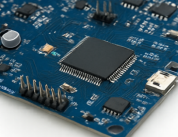
Each layer is like an independent discipline, following its own innovation curve and developing at its own pace. In the semiconductor field, we have pushed the technological boundary to the physical limit: using extreme ultraviolet lithography (EUV) technology, we etch circuit features at the nanometer level on a bare chip the size of a fingernail, integrating billions of transistors. Meanwhile, progress in the field of PCB design, which connects these wonders, has been much slower. We are still struggling with limitations in line width, impedance control, and manufacturing processes, and the progress in these areas is far behind that at the chip level.
The depth and speed of innovation at every level are astonishing, yet the coordination between them is minimal.
Although this independence promotes deep specialization, it also creates information silos. Few engineers - even enterprises - are able to fully integrate all levels of the entire system. This is not because engineers or companies are not working hard enough, but because each layer itself is a 'universe'. Therefore, the uneven development speed of technology at different levels is not due to laziness, but rather the result of deep specialization, which in turn leads to information silos.
Journey through various levels
Over the past twenty years, I have had the privilege of personally experiencing this complexity - from system design in Japan, to chip development and system integration in the United States, and now standing at the intersection of AI and embedded design. Every stage of my career has exposed me to a new level of technology.
In this process, what shocked me was not only the depth of each field, but also the fact that each layer often knew very little about each other - simulation designers rarely communicated with embedded software engineers; PCB layout experts often do not fully understand the behavior at the application level; System level decisions are often made without end-to-end visibility.
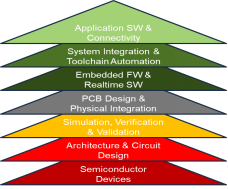
Experience has taught me that fragmentation in the field of embedded electronics is not accidental - it is a structural result determined by the design itself
1. Semiconductor devices (base layer): microcontrollers SoC、 Memory, sensors, power ICs, dedicated chips, passive components, involving device physics, process technology, chip architecture, and IP modules. This layer is a multi-layered structure.
2. Architecture and Circuit Design: Shaping the design layer of the system, covering analog/mixed signal design, power tree, clock and signal conditioning, component selection and design trade-offs, and schematic capture.
3. Simulation, validation, and confirmation: pre manufacturing simulation, predictive modeling, signal integrity analysis, thermal/EMI simulation, bench testing.
4. PCB design and physical integration: This is the implementation layer of the "orchestra" performance, involving physical constraints, routing geometry, via structure, thermal management, and manufacturability.
5. Embedded firmware and real-time software: an intangible layer that gives hardware life, covering real-time control, hardware abstraction, driver programs, hardware and firmware bridging, and debugging.
6. System integration and toolchain automation: the adhesive layer where firmware, hardware, applications, and reality intersect, including bridging of core hardware, firmware, and system submodules, as well as testing pipelines and development processes.
7. Application software and connectivity: a user interface bridge between machines and humans, involving use case and user interface design, data analysis, cloud integration, mobile applications, remote control, communication protocols, latency management, and UX design.
Consequence: Fragmentation caused by design - this layering is not accidental, but inevitable.
Every field has developed so deeply and rapidly that comprehensive mastery across levels has become almost impossible, resulting in:
·The toolchains are still isolated from each other, resulting in low efficiency in system integration and debugging;
·Professional knowledge is locked in specific fields, and few engineers can effectively collaborate across levels;
·The design cycle is therefore delayed because insights from one level often deviate when transmitted to other levels.
In short, the embedded electronics industry has abundant capabilities, but its execution is fragmented.
The call to break down hierarchical barriers
The next leap for embedded systems - true system level collaborative design, rapid prototyping, and AI assisted development - lies in connecting these independent ecosystems. This is not to smooth out its complexity, but to create shared abstraction layers, interoperable tools, and design frameworks that allow each expert to work collaboratively without having to master all the details.
Prior to this, we were still in a world where outstanding talents worked in parallel but rarely collaborated.
Before this, we will continue to live in a world where outstanding talents work in parallel but find it difficult to reach consensus. But this is also an opportunity.
About The Author
This is reported by Top Components, a leading supplier of electronic components in the semiconductor industry
They are committed to providing customers around the world with the most necessary, outdated, licensed, and hard-to-find parts.
Media Relations
Name: John Chen
Email: salesdept@topcomponents.ruThis is reported by Top Components, a leading supplier of electronic components in the semiconductor industry. They are committed to p with the most necessary, outdated, licensed, and hard-to-find parts.
Media Relations Name: John Chen
Email: salesdept@topcomponents.ru