Email: SalesDept@topcomponents.cc

Skype: jinda808@vip.163.com

QQ: 119294586

WeChat: 

WhatsApp: +8613027986268
Language Translation
- • English
- • Русский язык
* Please refer to the English Version as our Official Version.
* Please refer to the English Version as our Official Version.
Battery-powered equipment, ranging from small power tools and lawn mowers to large material handling equipment such as forklifts, pallet trucks, and automated guided vehicles, is increasingly becoming an ideal choice for industrial and construction applications. These battery charger systems must be reliable and durable, performing well in harsh outdoor industrial environments while maintaining a compact, lightweight design and eliminating the need for forced cooling. Furthermore, these battery charger systems may need to operate from 120 to 277 VAC, or even 480 VAC.
Silicon carbide (SiC) power switching devices are becoming a popular choice due to their faster switching speeds and superior low-loss operation, enabling increased power density without compromising performance. Furthermore, SiC supports new power factor topologies not possible with IGBT technology.
This article will focus on selecting the PFC stage for industrial chargers.

Introduction
Industrial battery chargers are required to charge a variety of batteries, such as lead-acid, nickel-metal hydride, and lithium-ion. Most new battery-based industrial equipment primarily uses 12V to 120V lithium-ion and lithium phosphate batteries. (Figure 1)
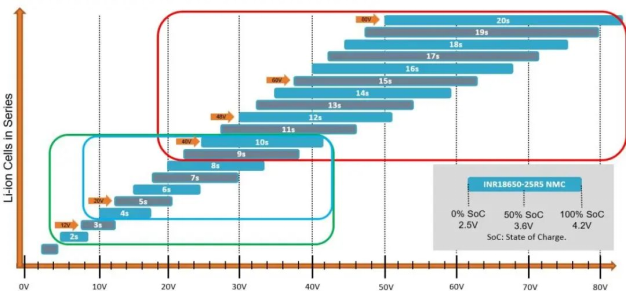
Figure 1. Typical Application of a Lithium-Ion Battery Pack
An industrial charger consists of a PFC front-end circuit and an isolated DC-DC converter stage with constant-voltage and constant-current control. (Figure 2)
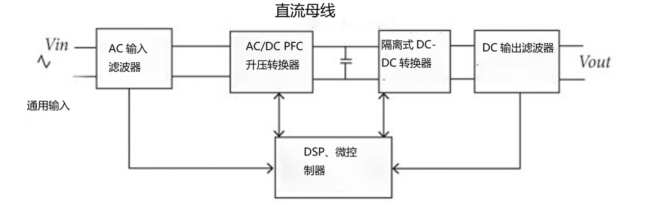
Figure 2. Typical Battery Charging System Block Diagram
In many designs, a microcontroller is used to program the charger to accommodate different battery voltages and current capacities. For faster and more efficient charging, a high-frequency charger is required. Intelligent battery charging systems detect the battery voltage and capacity and charge using a constant-voltage mode. They also adjust the required charge current by monitoring the battery voltage, current, and temperature. SiC MOSFETs operate stably at high operating frequencies and high temperatures, with low switching and conduction losses. These extremely low power losses enable battery chargers to achieve high power density and efficiency, requiring smaller heat sinks and enabling natural convection cooling.
PFC Stage Selection
Next, we will analyze these topologies and discuss their suitability for different battery-powered applications.
Boost PFC Topology
The continuous conduction mode boost PFC is a simple, low-cost solution. The boost topology consists of an input EMI filter, a bridge rectifier, a boost inductor, a boost FET, and a boost diode, as shown in Figure 3.
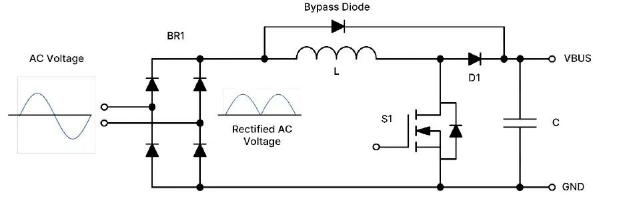
Figure 3. Boost PFC Topology
A fixed-frequency average-mode controller can be used to achieve high power factor and low total harmonic distortion (THD) while regulating the output voltage. ON Semiconductor's NCP1654 and NCP1655 CCM PFC controllers are recommended. For high-power applications, interleaved PFC controllers such as the FAN9672 and FAN9673 can be used. A 650V EliteSiC diode is recommended for the boost diode (D1). EliteSiC MOSFETs are suitable for high-frequency and high-power applications, such as 2 kW to 6.6 kW. Totem-pole PFC controller ICs with iGaN (integrated gate driver), such as the NCP1681, can be used in applications from 600 W to 1.0 kW. Silicon super-junction MOSFETs and IGBTs can be used in low-frequency applications from 20 kHz to 60 kHz.
In high-power applications, input bridge losses are significantly higher. Replacing diodes with active switches such as Si or SiC MOSFETs can reduce power losses. Semi-bridgeless PFC and totem-pole PFC topologies are very popular, eliminating the bridge rectifier and thus reducing losses.
Totem-pole PFC
The totem-pole PFC consists of an EMI filter, a boost inductor, a high-frequency half-bridge, a low-frequency half-bridge, a two-channel gate driver, and the fixed-frequency totem-pole PFC controller NCP1681B, as shown in Figure 4.
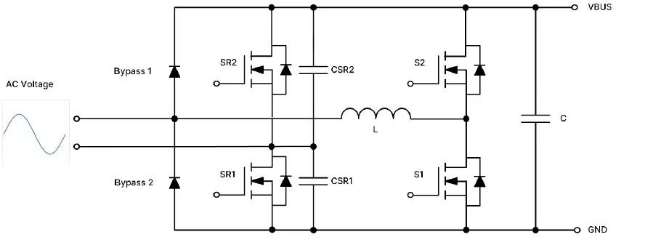
图 4.图腾柱 PFC拓扑
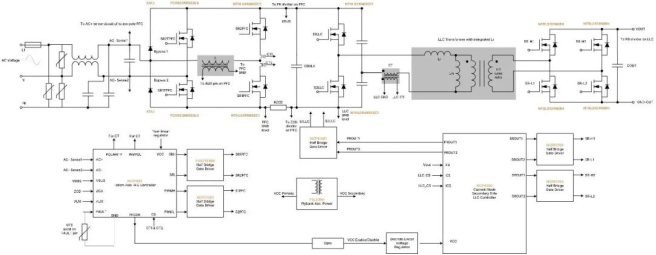
Figure 5. SiC-Based 3 kW Totem Pole PFC and LLC Power Supply
The high-frequency branch of the totem pole PFC requires a diode with low reverse recovery time integrated into the power switch. SiC and GaN power switches are suitable for the high-frequency branch of the totem pole PFC. ON Semiconductor recommends using iGaN with integrated gate drivers for applications from 600 W to 1.2 kW and SiC MOSFETs for applications from 1.5 kW to 6.6 kW. IGBTs with integrated SiC diodes can be used for applications from 20 to 40 kHz. Low RDS(on) silicon superjunction MOSFETs or low VCE(sat) IGBTs can be used for the low-frequency branch. Interleaved totem pole PFC can be used for applications from 4.0 kW to 6.6 kW.
The MOSFET-based totem pole PFC stage improves efficiency and power density by eliminating the bulky and lossy bridge rectifier. ON Semiconductor's 650V EliteSiC MOSFETs are well-suited for the high-frequency side of a totem-pole PFC. ON Semiconductor's 650V EliteSiC MOSFETs, such as the NTH4L045N065SC1 and NTH4L032N065M3S, are suitable for 3.0kW applications; the NTH4L015N065SC1 and the soon-to-be-released NTH4L012N065M3S are suitable for 6.6kW applications. The NTHL017N60S5H is suitable for the low-frequency side of a totem-pole PFC.
(Figure 5 shows an example of a 3kW SiC-based totem-pole PFC and LLC power supply.)
About The Author
This is reported by Top Components, a leading supplier of electronic components in the semiconductor industry. They are committed to p with the most necessary, outdated, licensed, and hard-to-find parts.
Media Relations
Name: John Chen
Email: salesdept@topcomponents.ru