Email: SalesDept@topcomponents.cc

Skype: jinda808@vip.163.com

QQ: 119294586

WeChat: 

WhatsApp: +8613027986268
Language Translation
- • English
- • Русский язык
* Please refer to the English Version as our Official Version.
* Please refer to the English Version as our Official Version.
On August 12, 2025, WPG Holdings, a leading international semiconductor component distributor serving the Asia-Pacific market, announced that its subsidiary, World Peace, has launched a universal automotive evaluation board solution based on NXP's S32K312 MCU, FS2303B secure power management chip, TJA1443ATK high-speed CAN transceiver, and TJA1021TK high-speed LIN transceiver.
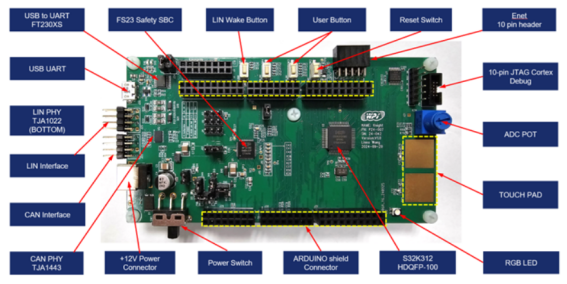
Figure 1 - Display of WPG's universal automotive evaluation board based on NXP products.
As the global automotive industry accelerates its transformation toward intelligent and electrified vehicles, the complexity and functional safety requirements of automotive electronic systems are increasing. To meet the industry's urgent need for rapid prototyping, functional safety certification, and development efficiency, WPG World Peace has launched a universal automotive evaluation board solution based on NXP's S32K312 MCU, FS2303B safety power management chip, and TJA1443ATK high-speed CAN transceiver and TJA1021TK high-speed LIN transceiver. This solution aims to help customers accelerate product innovation and quickly turn ideas into reality.
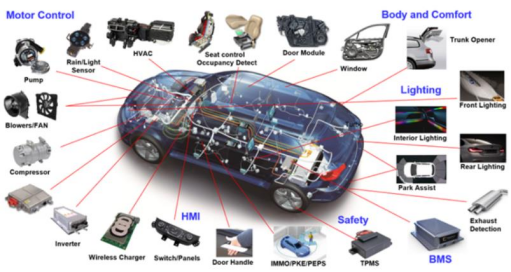
Figure 2 - Application scenario diagram of WPG World Peace's universal automotive evaluation board based on NXP products
The S32K312 is a member of NXP's S32K3 series of general-purpose automotive microcontrollers. Based on the ARM® Cortex®-M7 core, it supports single-core, dual-core, and lockstep core configurations. The S32K3 series offers scalability in core count, memory, and peripherals, complies with the ISO26262 standard, and features advanced functional safety, information security, and low power consumption, making it suitable for demanding body, zone control, and electrification applications. NXP's integrated, free S32DS development environment and real-time drivers allow customers to quickly develop S32K3-based application designs, significantly shortening product development cycles and meeting the rapidly evolving market demands for automotive electronics.
The FS2303B secure power management chip meets the stringent system stability and safety requirements of the next generation of automotive electronic control units (ECUs). It integrates a CAN transceiver, a LIN transceiver, a high-side driver, and a functional safety module. It supports configuration of specific functions via OTP (One-Time Programmable) and is adaptable to a variety of automotive application scenarios.
The TJA1443ATK high-speed CAN transceiver is an automotive-grade product. It supports standard HS CAN and CAN FD protocols and strictly adheres to ISO 11898-2:2016, SAE J2284-1-5, and SAE J1939-14, ensuring communication compatibility and compliance. In the CAN-FD fast phase, it achieves data rates of up to 5 Mbit/s, fully meeting the needs of high-speed data transmission.
The TJA1021TK high-speed LIN transceiver complies with the SAE J2602 standard and offers baud rates up to 20kB/s. In sleep mode, the TJA1021TK offers extremely low power consumption, further reduced in fault mode, and supports both local and remote wake-up. Regarding electromagnetic characteristics, the device exhibits extremely low electromagnetic emissions and exceptional electromagnetic immunity, making it suitable for the communication requirements of modern automotive systems.
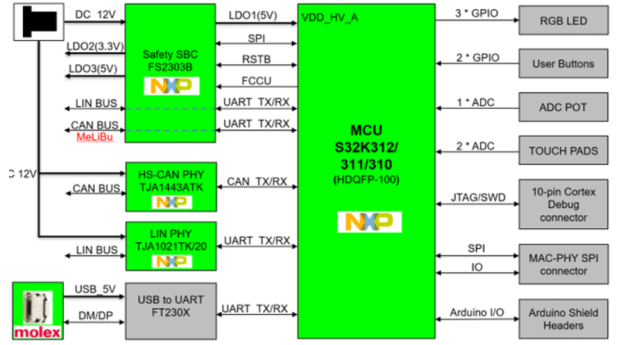
Figure 3 - Block diagram of the NXP-based automotive universal evaluation board from WPG World Peace.
In addition, the solution utilizes high-performance Molex connectors, providing critical support for the stable operation of the entire solution. Thanks to the outstanding performance of these components, this solution achieves ASIL-B functional safety while effectively optimizing costs. Furthermore, the solution supports the HSE safety engine, over-the-air (OTA), advanced connectivity, and low power consumption, meeting users' basic development needs. To further enhance the customer's product development experience, this evaluation board also includes Arduino UNO standard interfaces and compatibility with "Shield" expansion boards, facilitating product prototyping and significantly accelerating the process from design to implementation.
Core Technology Advantages:
Hardware Features:
The evaluation board measures 7cm x 13cm, making it lightweight and easy to use.
The S32K312, running the 32-bit Cortex-M7 in single-core mode, is housed in an HDQFP100 package, making it 55% smaller than standard ICs.
The FS2303B secure power management chip provides comprehensive power monitoring and fail-safe protection.
An onboard USB-to-UART module enables communication with a host computer without the need for an external converter.
Two high-speed CAN transceivers and two LIN transceivers enable end-to-end communication with the vehicle's ECU via the bus.
Components: 1 RGB LED, 2 user buttons, 1 potentiometer, and 2 electrode touchpads.
An Arduino UNO interface is provided for connecting to various development boards for application expansion.
Supports a 10-pin JTAG/SWD standard debug interface and 4-wire SWD debug mode.
Software Features:
Deeply integrated with the OEM RTD real-time driver software, the extensive official website provides a seamless development environment for users. This allows for the development of automotive-grade application software based on NXP's production-grade AUTOSAR® and Non-AUTOSAR® underlying drivers.
An independent HSE security subsystem, with NXP providing free security firmware and the HSE security engine, including AES-128/192/256, RSA, ECC, secure boot and key storage, side-channel protection, and compliance with ISO 21434.
S32 Secure Software Framework (SAF), including six fault detection and response libraries and free security peripheral drivers.
Structural Core Self-Test (SCST).
Free Inter-Core Communication Framework (IPCF), a middleware for communication between multi-core systems and multiple operating systems.
Free MATLAB Model Design Toolbox (MBDT), an NXP plug-in for the Simulink environment.
Solution Specifications:
• Automotive-grade SBC FS2303B power management chip:
• Tree-structured power rails for microcontrollers and sensors, with factory-configurable power-up and power-down sequencing for each rail;
• Three operating modes (normal, standby, and stop) manage low quiescent current and fast wake-up;
• Multiple wake-up sources: WAKE pin, HVIO/LVIO pins, CAN FD, LIN, or via SPI/I2C commands;
• Built-in high-side driver with cyclic sensing or wake-up source;
• Built-in one CAN-FD transceiver (up to 5 Mbit/s communication rate) and one LIN transceiver;
• Exposed pads on the QFN48 package optimize thermal management;
• Configurable and customizable via OTP programming memory;
• Meets functional safety level ADIL-B and complies with ISO26262 design and process standards;
It features power supervision, fault detection, MCU hardware monitoring, fail-safe protection, and advanced watchdog timer.
Automotive-grade high-speed CAN transceiver (TJA1443ATK):
Supports standard HS CAN and CAN FD, compliant with ISO 11898-2:2016, SAE J2284-1-5, and SAE J1939-14 standards;
Reliable communication at 5 Mbit/s data rates even in the CAN-FD fast phase;
Supports extremely low-current standby and sleep modes with local and remote wake-up capabilities;
Interface compatible with 3V and 5V microcontroller signals via the VIO input;
AEC-Q100 Grade 1 qualified (ambient temperature = 125°C); a dedicated TJR1443 version is available for high-temperature applications (ambient temperature = 150°C);
Compliant with IEC 61000-4-2, providing excellent ESD robustness of ±8 kV;
The compact HVSON14 package enhances automated optical inspection (AOI) capabilities.
Automotive-grade high-speed LIN transceiver (TJA1021TK) specifications:
Compliant with SAE J2602/SAE J2602 standards;
Baud rate up to 20 kBaud;
Extremely low power consumption in sleep mode, minimal power consumption in fault mode, and local and remote wake-up capabilities;
Input level compatibility with 3V and 5V devices, enabling direct connection to microcontrollers;
Extremely low electromagnetic emissions (EME) and high electromagnetic immunity (EMI);
Passive operation in the unpowered state;
Integrated termination resistors for LIN slave applications;
High ESD robustness: The LIN, VBAT, and WAKE_N pins can withstand ±6 kV ESD in accordance with IEC 61000-4-2;
Compact HVSON8 package improves automated optical inspection (AOI) capabilities.
About The Author
This is reported by Top Components, a leading supplier of electronic components in the semiconductor industry. They are committed to p with the most necessary, outdated, licensed, and hard-to-find parts.
Media Relations
Name: John Chen
Email: salesdept@topcomponents.ru