Email: SalesDept@topcomponents.cc

Skype: jinda808@vip.163.com

QQ: 119294586

WeChat: 

WhatsApp: +8613027986268
Language Translation
- • English
- • Русский язык
* Please refer to the English Version as our Official Version.
* Please refer to the English Version as our Official Version.
Silicon carbide (SiC) power switching devices are becoming a popular choice for industrial batteries due to their ability to achieve faster switching speeds and superior low-loss operation, thereby increasing power density without compromising performance. Furthermore, SiC enables new power factor topologies that are not possible with IGBT technology. This article will discuss isolated DC-DC power stage options.
Isolated DC-DC Power Stage Options
For isolated DC-DC conversion, several topologies can be selected depending on the power level of the application.
Half-Bridge LLC Topology
The half-bridge LLC topology with secondary-side full-bridge synchronous rectification is well suited for charger applications from 600W to 3.0kW. iGaN power switches are suitable for chargers from 600W to 1.0kW, while SiC MOSFETs are suitable for applications from 1.2kW to 3.0kW.
For applications from 4.0kW to 6.6kW, full-bridge LLC or interleaved LLC topologies are available; dual active bridges are suitable for applications from 6.0kW to 30.0kW. By paralleling multiple 6.0 kW chargers, power outputs ranging from 12.0 kW to 30 kW can be achieved.
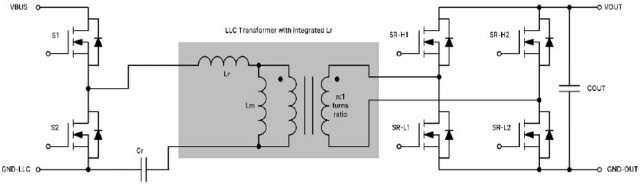
Figure 1. Half-Bridge LLC (Isolated LLC) Topology
The NTH4L045N065SC1 or NTBL032N065M3S 650 V EliteSiC MOSFETs are suitable for the primary-side half-bridge circuit, while 80 V to 150 V Si MOSFETs are suitable for secondary-side synchronous rectification applications. The NTBLS0D8N08X and NTBLS4D0N15MC are Si MOSFETs suitable for 48 V and 80 V to 120 V battery charger applications.
Full-Bridge LLC Topology
The full-bridge LLC topology consists of two half-bridges (S1-S2 and S3-S4), including the transformer primary winding Lm and the resonant LC network.
The diagonally arranged SiC MOSFETs in the full-bridge circuit are driven by the same gate drive signal. The secondary-side full-bridge LLC topology consists of two half-bridges (S5-S6 and S7-S8) using synchronously rectified Si MOSFETs. Bidirectional Si MOSFET switches S9-S10 provide voltage multiplication, enabling a wide output voltage range of 40 V to 120 V. For battery charger applications with a wide voltage range of 40 V to 120 V, a full-bridge LLC topology on the primary side and a synchronous full-bridge circuit with a bidirectional voltage doubler on the secondary side is a suitable solution (as shown in Figure 2).

Figure 2. Full-bridge LLC topology with secondary voltage doubler circuit
Figure 3 shows a full-bridge LLC topology with two transformers and two secondary full-bridge synchronous rectification circuits, suitable for applications from 4.0 kW to 6.6 kW.

Figure 3. Full-bridge LLC topology with two transformers and two full-bridge synchronous rectifiers
Interleaved Three-Phase LLC Topology
For high-power applications between 6.6 kW and 12.0 kW, the interleaved LLC topology is recommended to distribute power losses across multiple switches and transformers.
A three-phase interleaved LLC consists of three half-bridges (S1-S2, S3-S4, and S5-S6), three resonant LC circuits, and three transformers with magnetizing inductors. The secondary side uses three half-bridges (S7-S8, S9-S10, and S11-S12) with resonant LC networks to achieve bidirectional operation. The three primary-side half-bridges operate at the resonant switching frequency, 120 degrees out of phase with each other. This three-phase interleaved LLC topology produces output ripple at three times the switching frequency and significantly reduces the size of the filter capacitors.
The interleaved three-phase LLC topology shown in Figure 4 is suitable for charger applications ranging from 6.6 kW to 12 kW.

Figure 4. Interleaved Three-Phase LLC Topology
• Dual Active Bridge
The dual active bridge shown in Figure 5 is suitable for high-power charger applications, such as powering riding lawn mowers, forklifts, and electric motorcycles. The dual active bridge is suitable for industrial charger applications ranging from 6.6 kW to 11.0 kW.

Figure 5. Dual Active Bridge Topology
The single-stage topology is suitable for industrial charger applications with a single-phase AC input voltage of 120 to 347 V. The dual active bridge with bidirectional AC switches on the primary side, shown in Figure 6, is suitable for industrial charger applications ranging from 4.0 kW to 11.0 kW.

Figure 6. Single-Stage Dual Active Bridge Converter
650-750 V SiC MOSFETs and GaN HEMTs are suitable for bidirectional switching applications. The NTBL032N065M3S and NTBL023N065M3S 650 V EliteSiC MOSFETs are recommended for primary-side bidirectional switching. Bidirectional switching is achieved by integrating two die into a TOLL or TOLT package. GaN technology is also suitable for bidirectional switching applications.
Another interesting single-stage topology is the interleaved totem-pole PFC with an integrated full-bridge isolated LLC DC-DC converter, as shown in Figure 7.

Figure 7. Single-Stage Interleaved Totem-Pole PFC + LLC Stage
About The Author
This is reported by Top Components, a leading supplier of electronic components in the semiconductor industry. They are committed to p with the most necessary, outdated, licensed, and hard-to-find parts.
Media Relations
Name: John Chen
Email: salesdept@topcomponents.ru