Email: SalesDept@topcomponents.cc

Skype: jinda808@vip.163.com

QQ: 119294586

WeChat: 

WhatsApp: +8613027986268
Language Translation
- • English
- • Русский язык
* Please refer to the English Version as our Official Version.
* Please refer to the English Version as our Official Version.
Beijing, China, July 17, 2025 - As AI rapidly moves to the edge, the demand for intelligent edge devices has surged. However, deploying powerful models on small-sized microcontrollers remains a challenge for many developers. Developers need to consider data preprocessing, model selection, hyperparameter tuning, and optimization for specific hardware, and the learning curve is extremely steep. Therefore, developers certainly want to be able to easily build and deploy robust, resource-intensive machine learning models on edge devices such as microcontrollers and other constrained platforms without spending energy on complex code or hardware limitations.
Recently, we are pleased to announce that AutoML for Embedded, jointly developed by Analog Devices, Inc. (ADI) and Antmicro, is now available and integrated into the Kenning framework. Kenning is an open source platform that is not restricted by hardware and focuses on optimizing, benchmarking, and deploying AI models on edge devices. AutoML for Embedded aims to make efficient and scalable edge AI easy for all users, including embedded engineers and data scientists.
AutoML for Embedded opens up new possibilities, automating the end-to-end machine learning process, allowing less experienced developers to build high-quality models and enabling experts to significantly increase their experimental efficiency. The result is an efficient, lightweight model that is powerful without exceeding the performance limits of the device.
Seamless Integration with CodeFusion StudioTM and ADI Hardware
AutoML for Embedded is a Visual Studio Code plugin built on Kenning libraries, designed to fit naturally into developers' existing workflows. It integrates with CodeFusion StudioTM to support:
· ADI MAX78002 AI Accelerator MCU and MAX32690: Deploy models directly to advanced edge AI hardware.
· Emulation and RTOS Workflows: Rapidly prototype and test with Renode-based emulation and Zephyr RTOS.
· Common Open Source Tools: Enable flexible model optimization and avoid platform lock-in. With detailed step-by-step tutorials, reproducible processes, and sample data sets, developers can transform raw data into edge AI applications and deploy them at an amazing speed, even without a data science background.
Built for developers, supported by industry giants
AutoML for Embedded is the result of a deep collaboration between ADI and Antmicro, combining deep hardware technology expertise with open source innovation. We are committed to providing an open, user-centric, and scalable toolset to accelerate the adoption of edge AI in all industries.
"We have developed automated processes and VS Code plugins based on Kenning, a flexible open source AI benchmarking and deployment framework, to significantly reduce the complexity of building optimized edge AI models," said Michael Gielda, vice president of business development at Antmicro. "The core of our end-to-end development service is to create efficient workflows based on proven open source solutions to help customers achieve full control of their products. With Renode's flexible simulation capabilities and seamless integration with the highly configurable and standardized Zepher RTOS, it is now possible to use AutoML in the Kenning framework for transparent and efficient edge AI development."
How it works: Technical secrets
AutoML for Embedded uses advanced algorithms to automatically search and optimize models. It uses SMAC (Sequential Model-Based Algorithm Configuration) to efficiently explore model architectures and training parameters, and applies Hyperband and successive halving strategies to focus resources on the most promising models. At the same time, it checks the model size based on the device RAM to ensure smooth deployment.
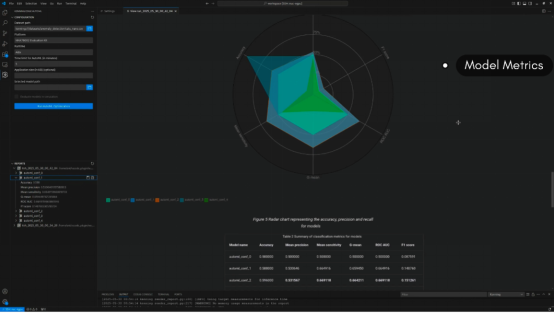
Candidate models can be optimized, evaluated, and benchmarked using Kenning's standard process, and detailed reports on model size, speed, and accuracy are generated to provide important basis for deployment decisions.
Real-world applications: Typical use cases
AutoML for Embedded is changing the development model of edge AI. For example, in a recent demonstration, developers used AutoML for Embedded to successfully create an anomaly detection model for sensor time series data on the ADI MAX32690 MCU. The model was deployed on both physical hardware and the Renode digital twin simulation platform, demonstrating seamless integration and real-time performance monitoring.
Other potential applications include:
· Image classification and object detection on low-power cameras
· Predictive maintenance and anomaly detection for industrial IoT sensors
· Natural language processing for on-device text analysis
· Real-time action recognition in sports events and robotics
Get started now
AutoML for Embedded is now available on the Visual Studio Code Marketplace and GitHub
AutoML for Embedded in the Visual Studio Marketplace
AutoML for Embedded on GitHub
Try it out, share your feedback, and help us shape the future of edge AI.
Interested in bringing AutoML for Embedded to your application projects? We look forward to working with customers who are exploring the potential of edge intelligence. If you are developing AI applications and would like support in optimizing or deploying models on embedded devices, please contact us.
Visit the Developer Portal to learn more about how we can support your project.
About Analog Devices
Analog Devices, Inc. (NASDAQ: ADI) is a leading global semiconductor company dedicated to bridging the physical and digital worlds to enable breakthrough innovations at the intelligent edge. ADI provides solutions combining analog, digital, and software technologies to drive the continued development of digital factories, automobiles, and digital healthcare, address climate change challenges, and build reliable connections between people and everything in the world. ADI's fiscal 2024 revenue exceeded $9 billion and it has approximately 24,000 employees worldwide. ADI enables innovators to continue to exceed all possibilities.About The Author
This is reported by Top Components, a leading supplier of electronic components in the semiconductor industry. They are committed to p with the most necessary, outdated, licensed, and hard-to-find parts.
Media Relations
Name: John Chen
Email: salesdept@topcomponents.ru