Email: SalesDept@topcomponents.cc

Skype: jinda808@vip.163.com

QQ: 119294586

WeChat: 

WhatsApp: +8613027986268
Language Translation
- • English
- • Русский язык
* Please refer to the English Version as our Official Version.
* Please refer to the English Version as our Official Version.
The ocean nurtures billions of lives and is crucial for regulating oxygen, climate, and biodiversity. However, there are still many unexplored areas in this vast underwater world. And National Geographic explorer Ved Chirayath is changing this situation. By ingeniously applying space exploration technology to ocean research, Chirayath has pioneered new methods for underwater mapping and imaging. His work not only reveals rare and fragile marine ecosystems, but also warns people of the urgency of ocean conservation and the importance of related conservation work by uncovering the mysterious wonders of the ocean.
Chirayath initially specialized in astrophysics and aerospace engineering, applying these research tools to oceanography and dedicated himself to solving many mysteries of underwater life. He shoulders a dual mission: to improve ocean mapping and research, and to develop technologies that will help search for extraterrestrial life in the future, as most known forms of life on Earth originate underwater. He applied physics innovation in the field of astronomy to overcome a major challenge in ocean exploration - how to penetrate water bodies and waves for clear observation. His method stems from several fundamental considerations: how did life originate? What secrets are hidden in our oceans? How can we protect these critical and fragile ecosystems before it's too late?
Chirayath's job requires high-performance computing to process large amounts of data in real-time. Arm's high-efficiency CPU technology can provide support for various advanced devices used by Chirayath, from enhancing underwater imaging capabilities to optimizing artificial intelligence (AI) ocean mapping. By constantly pushing the boundaries of exploration, Chirayath not only expands people's understanding of the deep sea, but also ensures that future generations can continue to explore in a sustainable way.
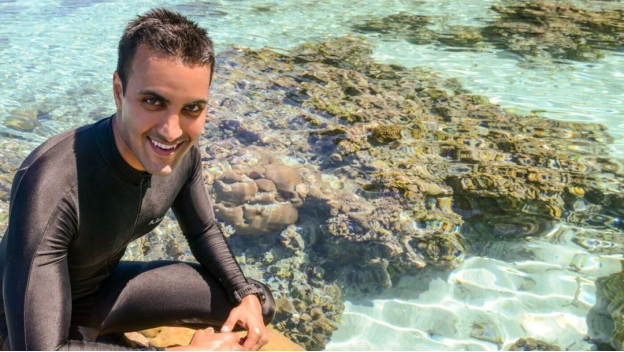
Fluid lens revolutionizes the field of underwater imaging
One breakthrough innovation achieved by Chirayath is fluid lens technology, which can effectively correct wave distortion and generate particularly clear 3D underwater environment images. The inspiration for this technology comes from the "gravitational lensing" phenomenon in astrophysics, where massive celestial bodies can bend and magnify light. This method utilizes the natural optical distortion of ocean waves to enhance underwater remote sensing capabilities.
Chirayath's breakthrough stems from years of experience in studying water surface distortion and amplifying object characteristics. He observed that waves naturally form curved lenses and realized that these distortions at the air-water interface could be useful for people. Fluid lensing technology first emerged during Chirayath's doctoral research at Stanford University, and has since been refined through subsequent projects. Today, this technology has fundamentally changed our ability to map coral reefs and marine biodiversity at high resolution, applying astronomical concepts to unexplored depths of the ocean.
Building on this success, Chirayath is developing a system he calls the "Ocean Edition James Webb Space Telescope," capable of exploring oceans at unprecedented depths and imaging them. By exploring various physical methods from weak particle emission to photoacoustic effects, he is dedicated to developing the next generation of ocean imaging equipment, which may be able to achieve efficient exploration of the deep sea in the future, just like telescopes penetrating the depths of the universe.
His research methodology is highly interdisciplinary, integrating aerospace engineering, computational modeling, and advanced robotics technology. Autonomous drones, aircraft, and satellites equipped with high-precision cameras and sensors are crucial for his research. These devices ensure that imaging technologies such as fluid lenses can be deployed on a large scale to investigate the vast marine environment covering over 70% of the Earth's surface and accounting for over 95% of the total biosphere volume.
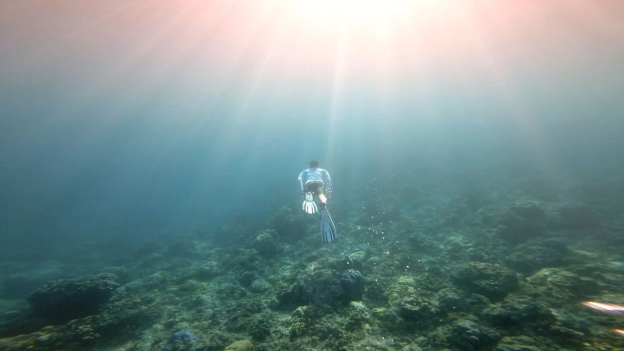
Arm processors enable energy-efficient ocean surveying technology to be realized
One major challenge facing Chirayath's research is energy efficiency, which is crucial when operating technology in remote marine environments, drones, or satellites. His early designs for fluid lens calculations required the use of supercomputers. Nowadays, high-performance desktop computers can perform these calculations, and in the future, they may even run on mobile devices. This transformation is due to advances in Arm processor technology, which focuses on energy-efficient computing and is aligned with improvements in CPU, GPU, and FPGA chips.
With the help of ARM based processors, Chirayath's team was able to shrink and optimize imaging tools for use in space and ocean applications. For example, CubeSats (small satellites that are only the size of shoe boxes and rely solely on solar energy for operation) require ultra-low power chips to operate efficiently in orbit. Similarly, drones used for ocean surveys must process large amounts of imaging data in real-time under strict power consumption limitations. Arm processors enable these systems to run complex algorithms with extremely low energy consumption, making them an essential technology for long-distance ocean exploration missions.
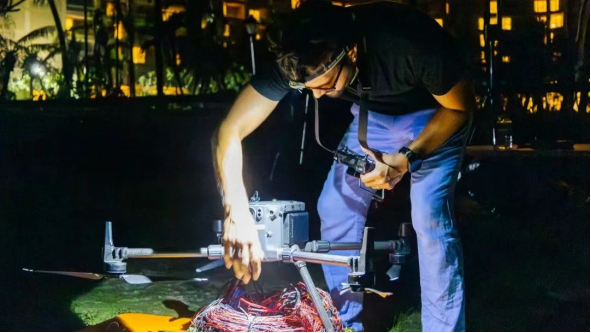
Promote ocean conservation and future exploration
Chirayath's innovation has had a profound impact on ocean conservation. His fluid lens technology has played an important role in creating detailed global coral reef maps and provided critical support for marine conservation efforts. After making these data public, researchers and regulators can better understand marine ecosystems, track environmental changes, and implement protective measures.
Looking ahead, his research is dedicated to promoting the widespread application of high-resolution ocean imaging technology among researchers and environmental protection workers. He envisions that one day these technologies will be as common as satellite images studying the terrestrial environment, allowing everyone to explore and monitor the marine environment with unprecedented clarity.
Breaking through the technological boundaries of underwater exploration
Chirayath's research is at the intersection of science, technology, and environmental protection. By expanding the boundaries of ocean exploration, he not only revealed the hidden mysteries of Earth, but also laid the foundation for the search for extraterrestrial life. He particularly emphasized the urgency of advancing imaging technology, as it not only concerns the exploration of Earth's oceans, but also involves the study of satellite oceans such as Europa and Titan. He pointed out that the current technological gap limits our ability to comprehensively study these environments, and warned that if we do not develop suitable tools, we may miss out on those significant discoveries.
Chirayath's work vividly demonstrates the tremendous power of interdisciplinary innovation and highlights the urgency of protecting the marine environment. He cleverly utilizes cutting-edge surveying, photography, and drone technology (all based on Arm's high-efficiency CPU technology) to explore and document marine ecosystems with unprecedented precision. By integrating space exploration technology with advanced computing, he not only revealed the mysteries of deep-sea life, but also promoted crucial marine conservation efforts.
This is reported by Top Components, a leading supplier of electronic components in the semiconductor industry
They are committed to providing customers around the world with the most necessary, outdated, licensed, and hard-to-find parts.
Media Relations
Name: John Chen
Email: salesdept@topcomponents.ru